
Commercial Concrete Contracting in Virginia
Large-scale concrete projects demand more than brute strength—they require precise planning, regulatory knowledge, and proven reliability. From industrial warehouse slabs to commercial sidewalks, loading docks, and CI paving, the role of a commercial concrete contractor in Virginia is multifaceted.
With Virginia’s regulatory environment and fluctuating climate, businesses need contractors who offer not only experience but also VA concrete compliance, equipment readiness, and safety certifications. This guide shows what to expect and how to select the right team.
Choosing the Right Company
Licensing & Bonding Requirements
Working with a bonded concrete contractor ensures financial protection in case of project abandonment, damages, or non-compliance. In Virginia, commercial work often requires Class A or B licensure, general liability insurance, and performance bonds.
These credentials guarantee that your contractor has the legal authority, financial backing, and professionalism to operate at scale. Always verify licensing through the Virginia DPOR (Department of Professional and Occupational Regulation).
Portfolio of Similar Projects
Past performance is a predictor of future outcomes. Review portfolios to confirm experience with concrete slab pours for commercial settings—especially in structures like parking decks, retail plazas, and industrial zones.
Ask for case studies that demonstrate problem-solving under pressure, adherence to timelines, and coordination with other subcontractors. If they’ve handled multi-phase projects or critical infrastructure, that’s a green flag.
Safety Certifications
Commercial job sites are high-risk zones. The best contractors maintain OSHA certifications, safety protocols, and on-site supervisors with fall protection and equipment training.
Some projects, like those near healthcare facilities or schools, require even stricter safety oversight. In Virginia, look for firms with EMR (Experience Modification Rate) below 1.0—a sign of consistent safety compliance.
Project Workflow
Pre-Construction Planning
Proper pre-construction saves time and money. Expect your contractor to conduct soil testing, site mapping, and scheduling based on access, utilities, and permits. Collaboration with structural engineers and architects should occur early.
In Arlington or Alexandria, where traffic and zoning are complex, pre-planning also includes staging areas, crane routes, and security fencing layouts.
Material Selection & Pour
Material choices must align with use-case demands. For example, industrial concrete services in VA often use high-performance mixes with lower water-cement ratios and additives like fly ash or silica fume.
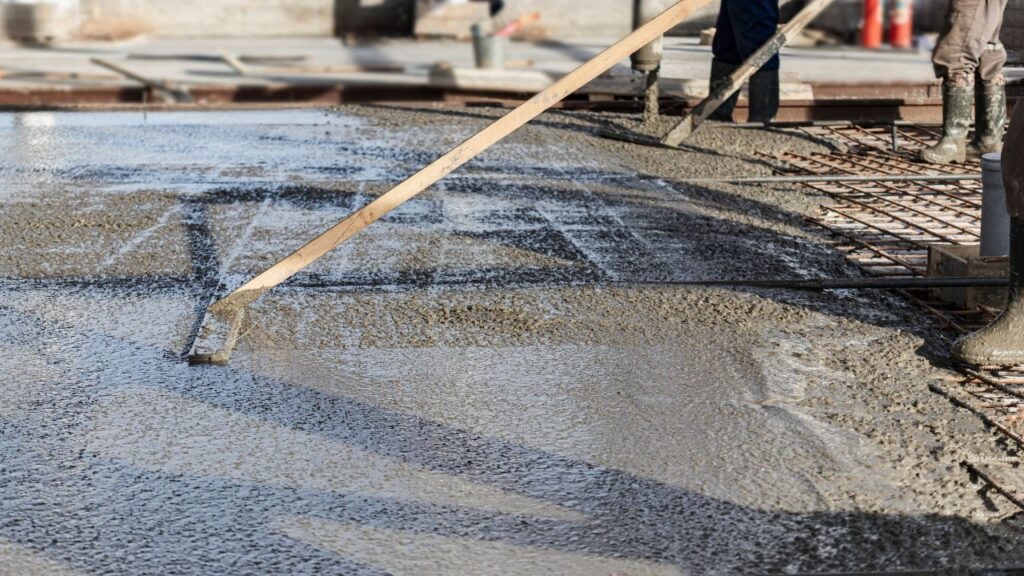
Pouring must be continuous and climate-sensitive. Hot, humid summers require different slump control than cold winters. Commercial pours may span days and require large batch coordination.
CI Paving & Finishing
CI (Continuous Improvement) paving emphasizes not only precision but also post-pour quality metrics. Surfaces must meet flatness and levelness specs (FF/FL scores), particularly for distribution centers and retail spaces.
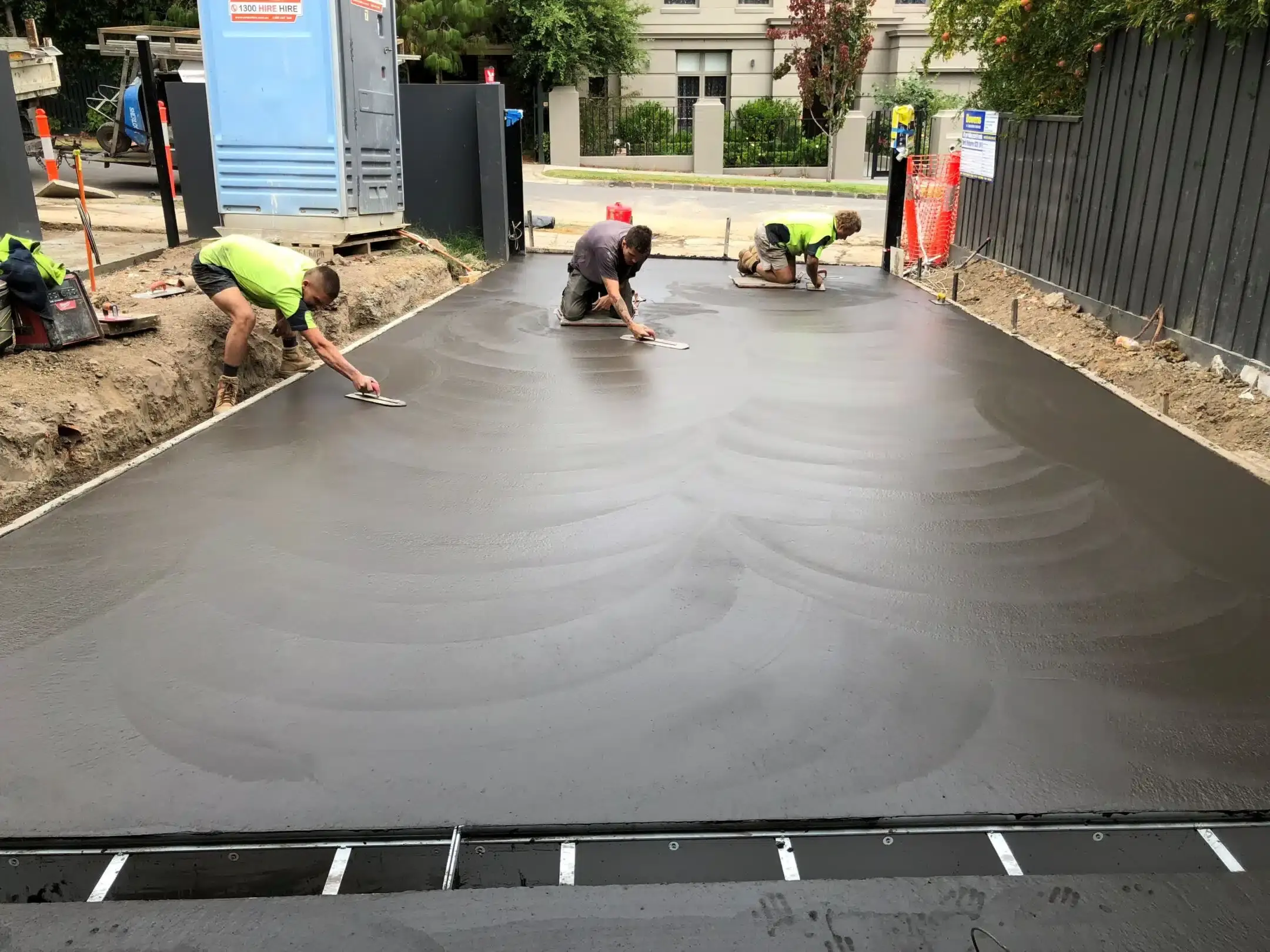
Finishing may involve brooming, troweling, curing compounds, or joint cutting—all sequenced for strength and appearance. In Woodbridge and Burke, where freeze-thaw is common, additional air entrainment and sealers are essential.
Quality Assurance & Compliance
Load-Bearing Tests
Commercial slabs must support heavy equipment, foot traffic, or storage loads. Testing includes compressive strength checks, core sampling, and deflection measurement post-cure.
Some facilities also require tensile testing or scanning for embedded steel. These steps ensure your concrete slab pour commercial meets code—and won’t fail under pressure.
ADA & Local Codes
Commercial projects must meet ADA accessibility standards. That includes proper ramp gradients, tactile warning strips, and compliant curb transitions. Contractors must be fluent in these requirements.
VA concrete compliance also means aligning with stormwater runoff laws, grading permits, and regional soil specs. Non-compliance can halt projects, trigger fines, or require costly rework.
Comparison Table: Bonded vs. Non-Bonded Contractors
| Feature | Bonded Concrete Contractor | Non-Bonded Contractor |
| Financial Protection | Covers losses due to non-performance | No protection if the contractor defaults |
| Licensing & Insurance | Required for bonding | May lack Class A/B license or full insurance |
| Project Size Experience | Proven track record on large jobs | Often limited to smaller residential work |
| Risk Mitigation | Thorough pre-con and safety processes | May lack structured QA/QC procedures |
| Cost Predictability | Fixed bids with legal accountability | Higher risk of cost overruns or delays |
| VA Compliance Knowledge | Fluent in state/local codes | May be unfamiliar with regulations |
Table Explanation: Hiring a bonded concrete contractor isn’t just about paperwork—it’s about risk reduction. They’ve been vetted for financial stability, technical ability, and legal compliance. For commercial work, that assurance is non-negotiable.
Local Insights: Commercial Projects in Virginia
In Great Falls, Clifton, and Oakton, commercial clients face complex logistics due to elevation changes and soil variations. Hiring a team that understands geotechnical impact can save months of schedule risk.
Areas like Annandale and Alexandria deal with historic zoning overlays. Here, contractors must coordinate with municipal engineers and historic preservation boards. Local expertise matters.
Concrete Contractors Virginia brings regional familiarity, skilled crews, and scalable project management systems. Their experience with industrial concrete services in VA ensures alignment with your budget and timeline.
FAQs
- Do commercial pours require structural engineer approval?
Yes. For most structural slabs, retaining walls, and high-load areas, structural engineers must approve the design, reinforcement layout, and pour sequence. This safeguards load distribution and code compliance. Engineers also verify slab thickness and edge support requirements. Without their input, permits may be denied. - What is CI paving?
CI paving refers to paving processes that implement continuous improvement standards—emphasizing finish quality, speed, and durability. It often uses real-time feedback tools like laser screeds and quality tracking metrics. CI practices reduce rework and enhance operational efficiency. It’s ideal for logistics hubs and warehouse floors. - How are ADA requirements ensured?
ADA compliance includes specific requirements for slope (no more than 1:12), width (minimum 36 inches), and surface texture. Contractors ensure this by integrating compliance into the design and verifying during each stage. Inspections occur pre- and post-pour. Mistakes in ADA details can lead to lawsuits or rejection at final inspection. - What type of steel reinforcement is used?
Common reinforcements include rebar (Grade 60) and welded wire mesh. For elevated slabs or seismic zones, post-tensioned cables or epoxy-coated rebar may be used. Reinforcement type is determined by slab load, use case, and environmental exposure. Engineering specs guide every reinforcement decision. - How fast can floors be commissioned after pour?
Basic access for foot traffic is usually allowed after 24–48 hours. For full load-bearing use, wait 7 to 28 days, depending on curing conditions and mix strength. Accelerators can reduce wait times. Moisture content and flatness must be verified before installing flooring or fixtures.
Commercial Strength, Built to Last
Choosing the right concrete partner for your commercial project means investing in reliability, safety, and compliance from the ground up. Virginia businesses deserve a contractor who brings more than tools—they bring trust, transparency, and technical excellence. A well-executed commercial concrete job doesn’t just meet specs—it sets the foundation for years of uninterrupted operations.
Whether it’s a high-traffic retail floor, a precision-leveled warehouse slab, or ADA-compliant access routes, your contractor must understand local code, anticipate site challenges, and coordinate seamlessly with project stakeholders. Mistakes in this field are costly, not just financially but in downtime and liability.
Concrete Contractors Virginia delivers comprehensive service from permitting to pour, including commercial slab pours, ADA oversight, CI-grade finishes, and post-pour quality assurance. Their knowledge of regional requirements, coupled with a track record of timely and safe delivery, makes them the trusted name in industrial concrete services in VA.
Partnering with the right team ensures your commercial build doesn’t just stand—it excels.
Epoxy Flooring That Lasts – Get Your Free Estimate!

Leave A Comment